
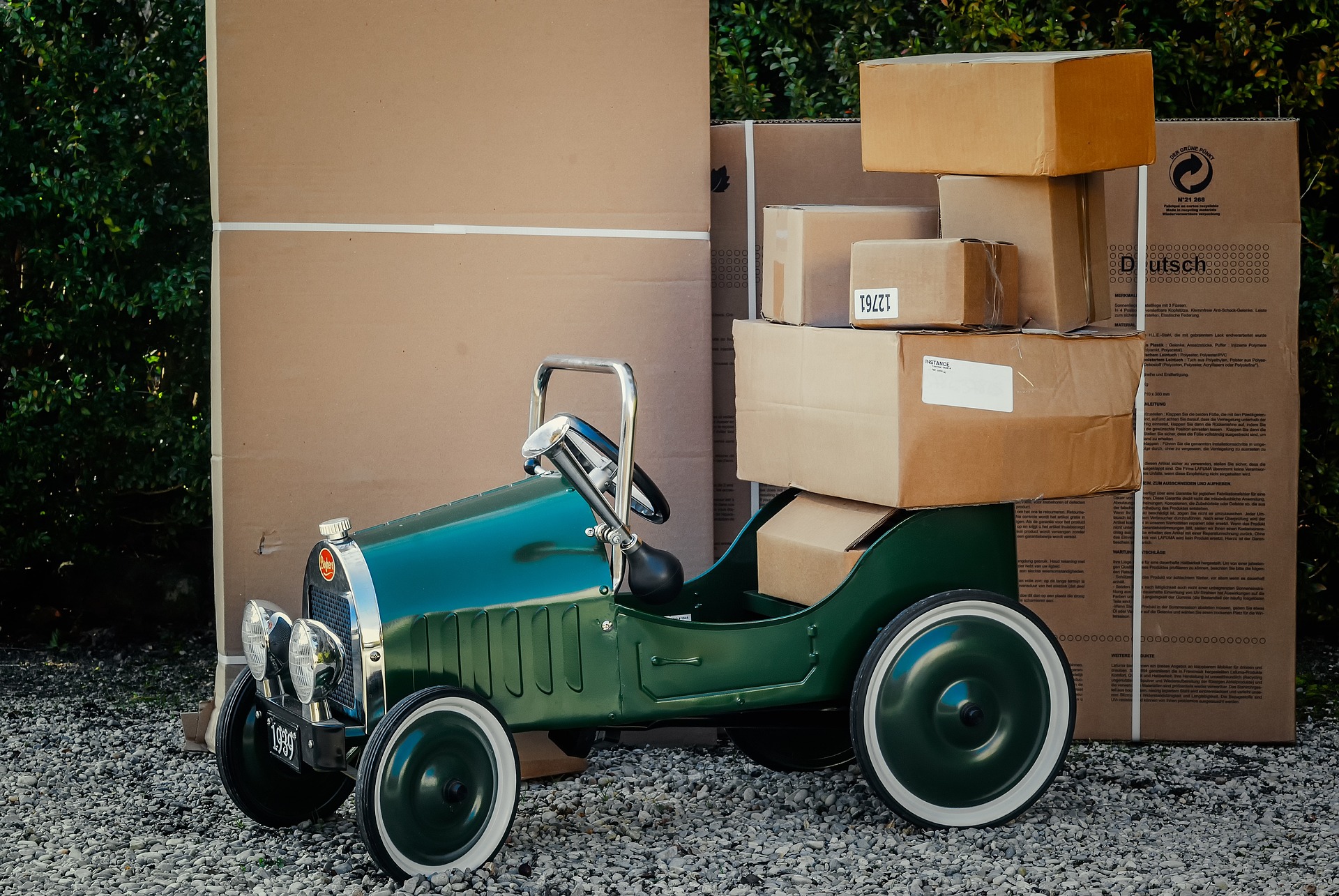
Packaging is the science, art and technology of enclosing or protecting products for distribution, storage, sale, and use. Packaging also refers to the process of designing, evaluating, and producing packages. Packaging can be described as a coordinated system of preparing goods for transport, warehousing, logistics, sale, and end use. Packaging contains, protects, preserves, transports, informs, and sells. In many countries it is fully integrated into government, business, institutional, industrial, and personal use.
History of packaging
Ancient era
The first packages used the natural materials available at the time: baskets of reeds, wineskins (bota bags), wooden boxes, pottery vases, ceramic amphorae, wooden barrels, woven bags, etc. Processed materials were used to form packages as they were developed: first glass and bronze vessels. The study of old packages is an essential aspect of archaeology.
The first usage of paper for packaging was sheets of treated mulberry bark used by the Chinese to wrap foods as early as the first or second century B.C.
The usage of paper-like material in Europe was when the Romans used low grade and recycled papyrus for the packaging of incense.
The earliest recorded use of paper for packaging dates back to 1035, when a Persian traveller visiting markets in Cairo, Arab Egypt, noted that vegetables, spices and hardware were wrapped in paper for the customers after they were sold.
Modern era
Tinplate
The use of tinplate for packaging dates back to the 18th century. The manufacturing of tinplate was the monopoly of Bohemia for a long time; in 1667 Andrew Yarranton, an English engineer, and Ambrose Crowley brought the method to England where it was improved by ironmasters including Philip Foley. By 1697, John Hanbury had a rolling mill at Pontypool for making “Pontypoole Plates”. The method pioneered there of rolling iron plates by means of cylinders enabled more uniform black plates to be produced than was possible with the former practice of hammering.
Tinplate boxes first began to be sold from ports in the Bristol Channel in 1725. The tinplate was shipped from Newport, Monmouthshire. By 1805, 80,000 boxes were made and 50,000 exported. Tobacconists in London began packaging snuff in metal-plated canisters from the 1760s onwards.
The purposes of packaging and package labels
Physical protection – The objects enclosed in the package may require protection from, among other things, mechanical shock, vibration, electrostatic discharge, compression, temperature, etc.
Barrier protection – A barrier to oxygen, water vapor, dust, etc., is often required. Permeation is a critical factor in design. Some packages contain desiccants or oxygen absorbers to help extend shelf life. Modified atmospheres or controlled atmospheres are also maintained in some food packages. Keeping the contents clean, fresh, sterile and safe for the duration of the intended shelf life is a primary function. A barrier is also implemented in cases where segregation of two materials prior to end use is required, as in the case of special paints, glues, medical fluids, etc.
Containment or agglomeration – Small objects are typically grouped together in one package for reasons of storage and selling efficiency. For example, a single box of 1000 marbles requires less physical handling than 1000 single marbles. Liquids, powders, and granular materials need containment.
Information transmission – Packages and labels communicate how to use, transport, recycle, or dispose of the package or product. With pharmaceuticals, food, medical, and chemical products, some types of information are required by government legislation. Some packages and labels also are used for track and trace purposes. Most items include their serial and lot numbers on the packaging, and in the case of food products, medicine, and some chemicals the packaging often contains an expiry/best-before date, usually in a shorthand form. Packages may indicate their construction material with a symbol.
Marketing – Packaging and labels can be used by marketers to encourage potential buyers to purchase a product. Package graphic design and physical design have been important and constantly evolving phenomena for several decades. Marketing communications and graphic design are applied to the surface of the package and often to the point of sale display. Most packaging is designed to reflect the brand’s message and identity on the one hand while highlighting the respective product concept on the other hand.
Security – Packaging can play an important role in reducing the security risks of shipment. Packages can be made with improved tamper resistance to deter manipulation and they can also have tamper-evident features indicating that tampering has taken place. Packages can be engineered to help reduce the risks of package pilferage or the theft and resale of products: Some package constructions are more resistant to pilferage than other types, and some have pilfer-indicating seals. Counterfeit consumer goods, unauthorized sales (diversion), material substitution and tampering can all be minimized or prevented with such anti-counterfeiting technologies. Packages may include authentication seals and use security printing to help indicate that the package and contents are not counterfeit. Packages also can include anti-theft devices such as dye-packs, RFID tags, or electronic article surveillance tags that can be activated or detected by devices at exit points and require specialized tools to deactivate. Using packaging in this way is a means of retail loss prevention.
Convenience – Packages can have features that add convenience in distribution, handling, stacking, display, sale, opening, reclosing, using, dispensing, reusing, recycling, and ease of disposal
Portion control – Single serving or single dosage packaging has a precise amount of contents to control usage. Bulk commodities (such as salt) can be divided into packages that are a more suitable size for individual households. It also aids the control of inventory: selling sealed one-liter bottles of milk, rather than having people bring their own bottles to fill themselves.
Branding/Positioning – Packaging and labels are increasingly used to go beyond marketing to brand positioning, with the materials used and design chosen key to the storytelling element of brand development. Due to the increasingly fragmented media landscape in the digital age this aspect of packaging is of growing importance.
Package development considerations
Package design and development are often thought of as an integral part of the new product development process. Alternatively, the development of a package (or component) can be a separate process but must be linked closely with the product to be packaged. Package design starts with the identification of all the requirements: structural design, marketing, shelf life, quality assurance, logistics, legal, regulatory, graphic design, end-use, environmental, etc. The design criteria, performance (specified by package testing), completion time targets, resources, and cost constraints need to be established and agreed upon. Package design processes often employ rapid prototyping, computer-aided design, computer-aided manufacturing and document automation.
An example of how package design is affected by other factors is its relationship to logistics. When the distribution system includes individual shipments by a small parcel carrier, the sorting, handling, and mixed stacking make severe demands on the strength and protective ability of the transport package. If the logistics system consists of uniform palletized unit loads, the structural design of the package can be designed to meet those specific needs, such as vertical stacking for a longer time frame. A package designed for one mode of shipment may not be suited to another.
With some types of products, the design process involves detailed regulatory requirements for the packaging. For example, any package components that may contact foods are designated food contact materials. Toxicologists and food scientists need to verify that such packaging materials are allowed by applicable regulations. Packaging engineers need to verify that the completed package will keep the product safe for its intended shelf life with normal usage. Packaging processes, labeling, distribution, and sale need to be validated to assure that they comply with regulations that have the well being of the consumer in mind.
Sometimes the objectives of package development seem contradictory. For example, regulations for an over-the-counter drug might require the package to be tamper-evident and child resistant: These intentionally make the package difficult to open. The intended consumer, however, might be disabled or elderly and unable to readily open the package. Meeting all goals is a challenge.
Package design may take place within a company or with various degrees of external packaging engineering: independent contractors, consultants, vendor evaluations, independent laboratories, contract packagers, total outsourcing, etc. Some sort of formal project planning and project management methodology is required for all but the simplest package design and development programs. An effective quality management system and Verification and Validation protocols are mandatory for some types of packaging and recommended for all.
Packaging machinery
Choosing packaging machinery includes an assessment of technical capabilities, labor requirements, worker safety, maintainability, serviceability, reliability, ability to integrate into the packaging line, capital cost, floorspace, flexibility (change-over, materials, multiple products, etc.), energy requirements, quality of outgoing packages, qualifications (for food, pharmaceuticals, etc.), throughput, efficiency, productivity, ergonomics, return on investment, etc.
Packaging machinery can be:
- purchased as standard, off-the-shelf equipment
- purchased custom-made or custom-tailored to specific operations
- manufactured or modified by in-house engineers and maintenance staff
Efforts at packaging line automation increasingly use programmable logic controllers and robotics.
Packaging machines may be of the following general types:
- Accumulating and collating machines
- Blister packs, skin packs and vacuum packaging machines
- Bottle caps equipment, over-capping, lidding, closing, seaming and sealing machines
- Box, case, tray, and carrier forming, packing, unpacking, closing, and sealing machines
- Cartoning machines
- Cleaning, sterilizing, cooling and drying machines
- Coding, printing, marking, stamping, and imprinting machines
- Converting machines
- Conveyor belts, accumulating and related machines
- Feeding, orienting, placing and related machines
- Filling machines: handling dry, powdered, solid, liquid, gas, or viscous products
- Inspecting: visual, sound, metal detecting, etc.
- Label dispenser
- Orienting, unscrambling machines
- Package filling and closing machines
- Palletizing, depalletizing, unit load assembly
- Product identification: labeling, marking, etc.
- Sealing machines: heat sealer or glue units
- Slitting machines
- Weighing machines: check weigher, multihead weigher
- Wrapping machines: stretch wrapping, shrink wrap, banding
- Form, fill and seal machines
- Other specialty machinery: slitters, perforating, laser cutters, parts attachment, etc.
Packaging engineering
Packaging engineering, also package engineering, packaging technology and packaging science, is a broad topic ranging from design conceptualization to product placement. All steps along the manufacturing process, and more, must be taken into account in the design of the package for any given product. Package engineering is an interdisciplinary field integrating science, engineering, technology and management to protect and identify products for distribution, storage, sale, and use. It encompasses the process of design, evaluation, and production of packages. It is a system integral to the value chain that impacts product quality, user satisfaction, distribution efficiencies, and safety. Package engineering includes industry-specific aspects of industrial engineering, marketing, materials science, industrial design and logistics. Packaging engineers must interact with research and development, manufacturing, marketing, graphic design, regulatory, purchasing, planning and so on. The package must sell and protect the product, while maintaining an efficient, cost-effective process cycle.
Engineers develop packages from a wide variety of rigid and flexible materials. Some materials have scores or creases to allow controlled folding into package shapes (sometimes resembling origami). Packaging involves extrusion, thermoforming, molding and other processing technologies. Packages are often developed for high speed fabrication, filling, processing, and shipment. Packaging engineers use principles of structural analysis and thermal analysis in their evaluations.
Education
Formal packaging programs might be listed as package engineering, packaging science, packaging technology, etc. BE, BS, MS, M.Tech and PhD programs are available. Students in a packaging program typically begin with generalized science, business, and engineering classes before progressing into industry-specific topics such as shelf life stability, corrugated box design, cushioning, engineering design, labeling regulations, project management, food safety, robotics, RFID tags, quality management, package testing, packaging machinery, tamper-evident methods, recycling, computer-aided design, etc.